
Perseus Cluster, Abell 426
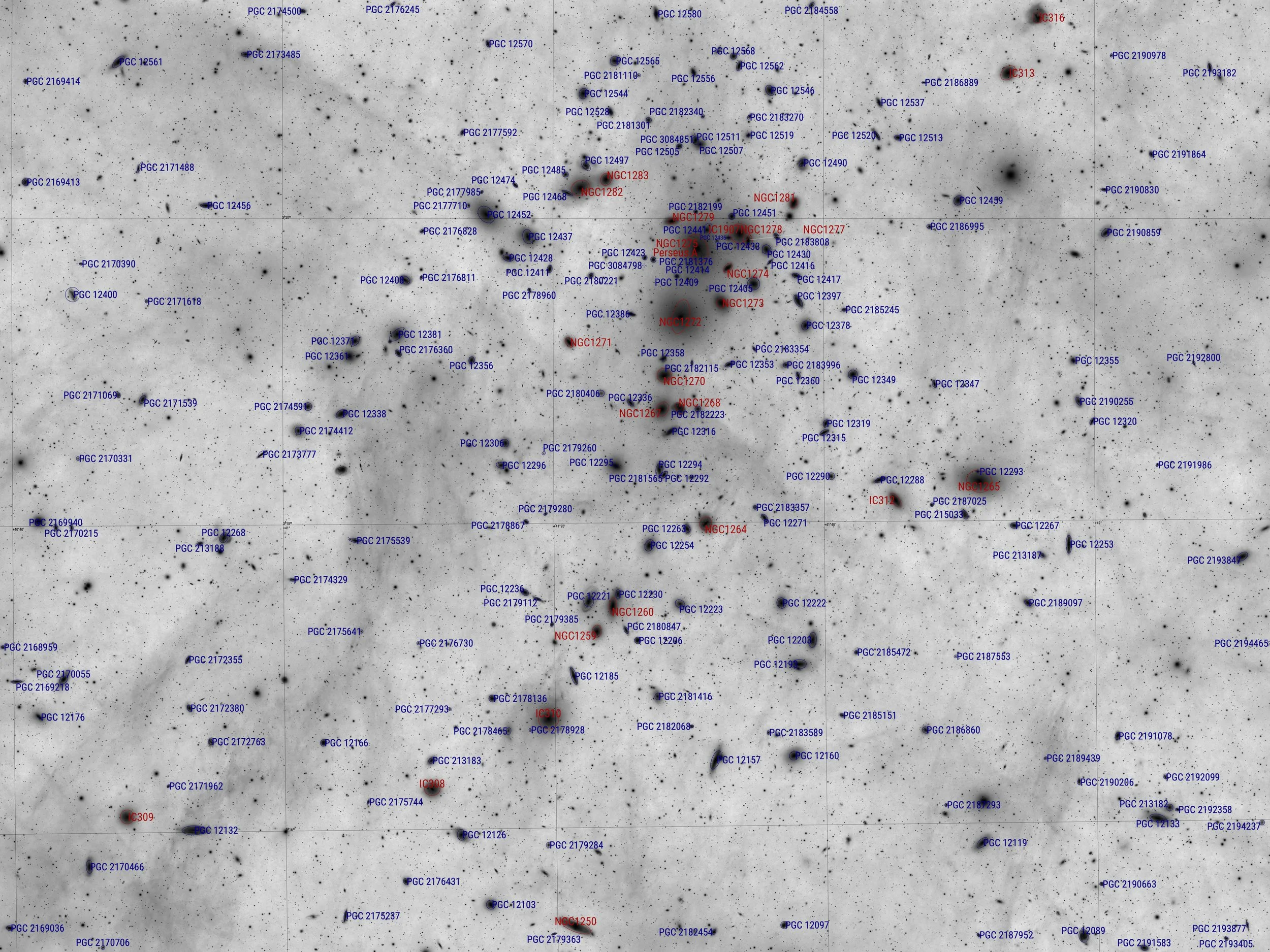
Annotated Image (NGC, IC, and PGC Catalogs)
Central Crop (rotated 90 degrees counter clockwise)
About the Subject
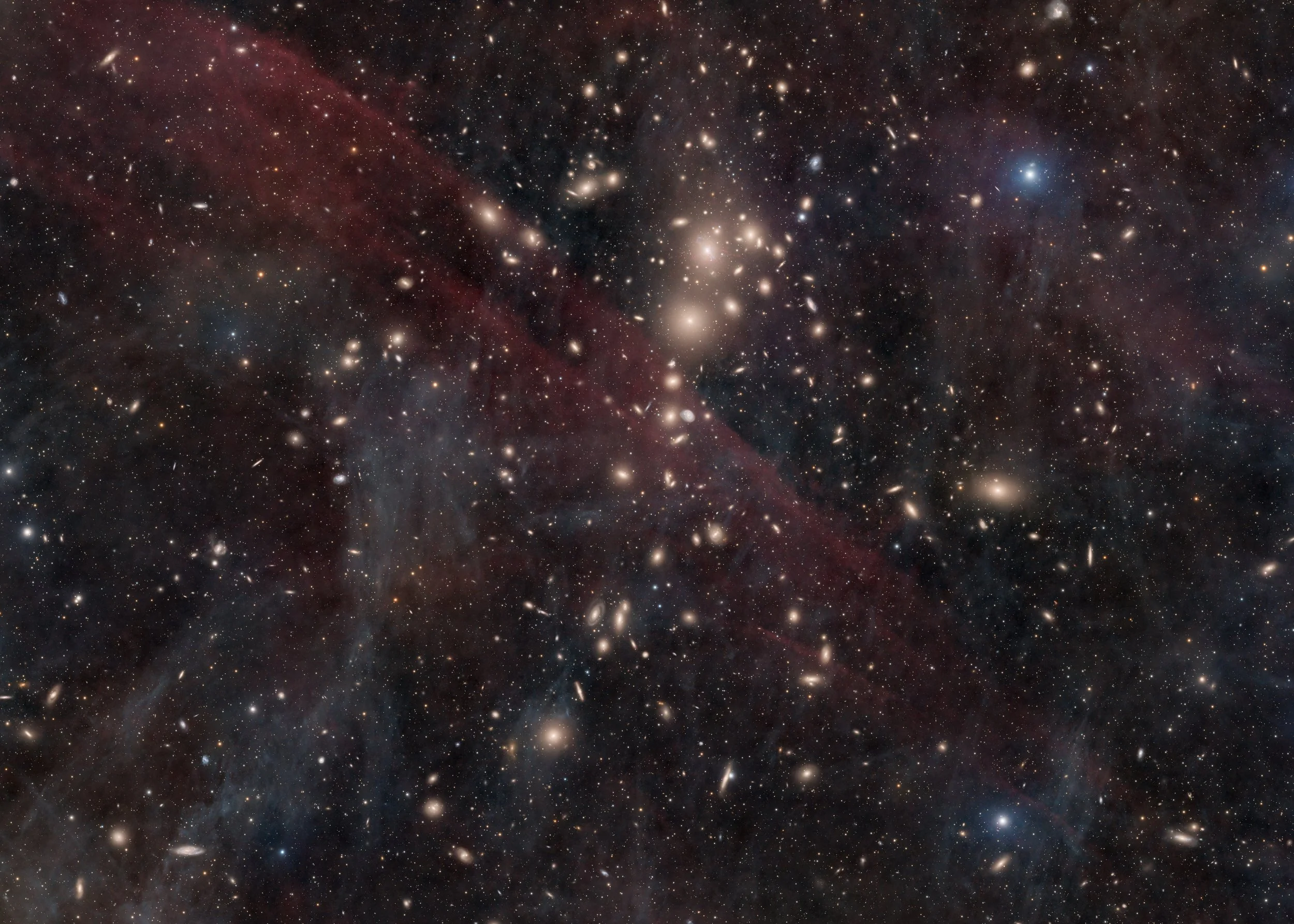
Abell 426 is a massive galaxy cluster in the constellation Perseus. It lies at a distance of roughly 245 million light years. It contains over one thousand galaxies bound together by their collective gravity and spans approximately sixty million light years which makes it one of the largest galaxy clusters known.
While there are over 1,000 galaxies in the Perseus Cluster, this image is deep enough to include several thousand background galaxies as well, down to twenty-first magnitude. Many of the much smaller, fainter galaxies in the image are much farther away than Abell 426 itself.
While there are a fair number of spiral galaxies within Abell 426, the cluster is dominated by giant ellipticals. The cluster appears redder than most galaxy images we are used to for a combination of three reasons. First, most of the galaxies within the cluster are not experiencing much star formation, so their light is dominated by older, less massive stars that tend to be redder than hotter, younger stars. Second, the cluster is far enough away that the expansion of the universe itself causes shift from blue towards red of about 10-12nm. That’s not a huge difference, but it’s enough to be visible. Finally, when we are looking at Abell 426 we are looking through a fair amount of dust within the Milky Way itself. This dust preferentially scatters blue wavelengths, contributing to the reddish hues of the cluster. These three factors combined generate the golden/yellow color that dominates the cluster.
The bluish cloud structure visible throughout the image is “galactic cirrus” and is actually a foreground object. It is caused by dust particles distributed throughout the Milky Way scattering the combined light of the Milky Way galaxy itself. The red bands within the image also come from sources within the Milky Way, specifically diffuse ionized hydrogen gas.
About the Image
The data for this image were captured between November 2 and November 13, 2026 from Deep Sky West observatory in Rowe, NM. NINA was used for image capture, APCC was used to control the mount, and PixInsight was used for image pre-processing and post.
Location, and Equipment:
Rowe, NM, USA
Astro-Physics 305mm Riccardi-Honders Cassegrain @ f/3.8
Astro-Physics 1100GTO AE Mount with Absolute Encoders
QHY600PH Monochrome Camera at -10°C
Chroma 50mm x 50mm filters
3nm H-Alpha
RGB
Total integration time of 65h 16m (14h 28m red, 14h 36m green, 14h 32m blue, 21h 40m Ha)
Software:
Astro-Physics APCC for mount control and advanced pointing model
NINA for autofocus, sequence of images, and camera control
PHD2 for guiding
PixInsight for calibration and all post processing
Central Crop
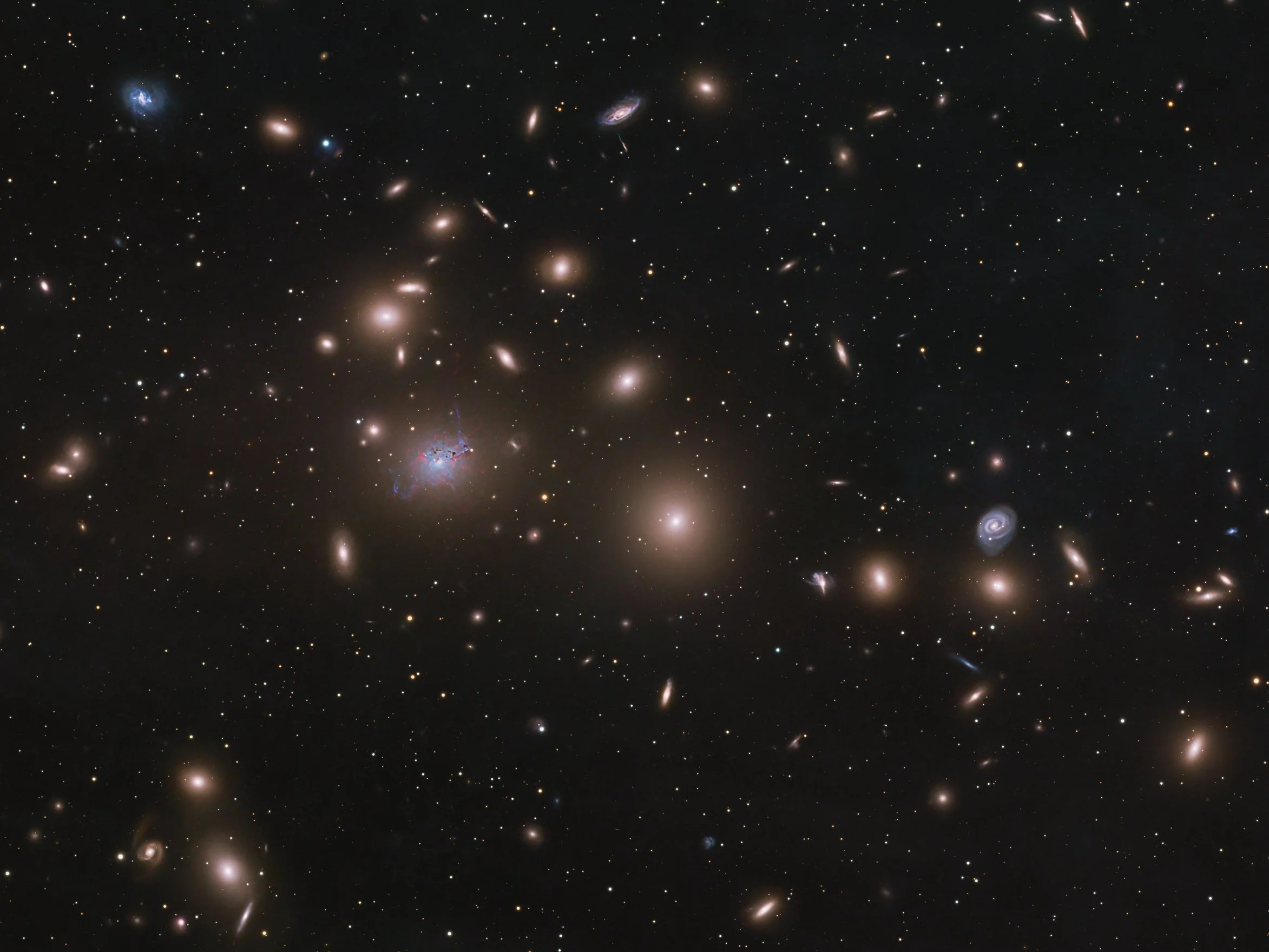
At the core of the Perseus Cluster lies the type 1.5 Seyfert galaxy Perseus A (NGC 1275). It can be seen towards the center/left of the cropped image as a colorful, distorted galaxy. It contains a central supermassive black hole of roughly 800 million solar masses. The black hole is actively accreting large amounts of material and is outputting intense radio and x-rays. You can see the fine, filamentary structure of gas surrounding the galaxy. The central cluster galaxy contains a massive network of spectral line emitting filaments, which are being dragged out by rising bubbles of relativistic plasma generated by the central active galactic nucleus. Long gaseous filaments made up of threads of gas stretch out beyond the galaxy, into the multimillion-degree, X-ray–emitting gas that fills the cluster. The amount of gas contained in a typical thread is approximately one million times the mass of the Sun. They are only 200 light-years wide, are often very straight, and extend for up to 20,000 light-years.