
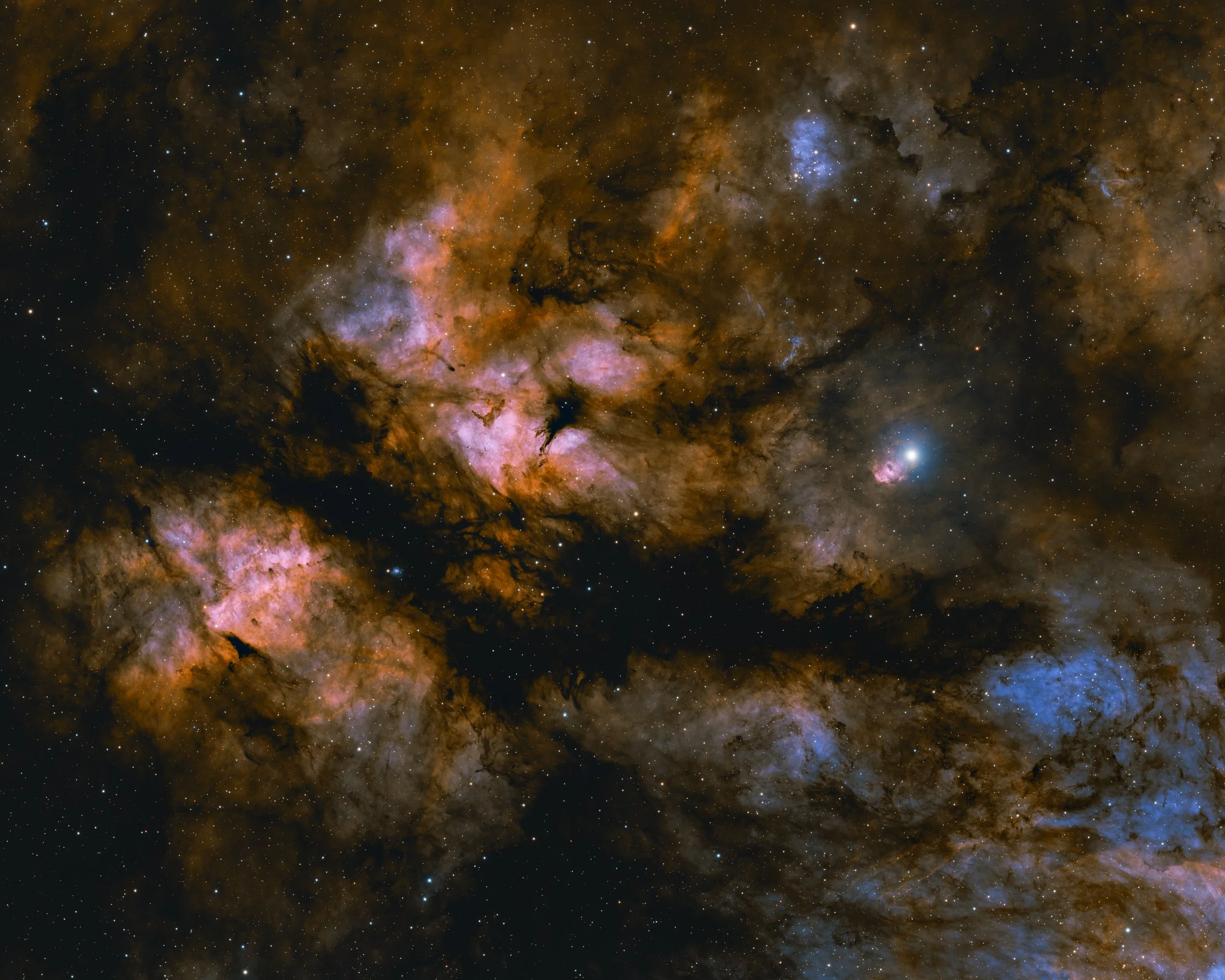
Butterfly Nebula, IC 1318
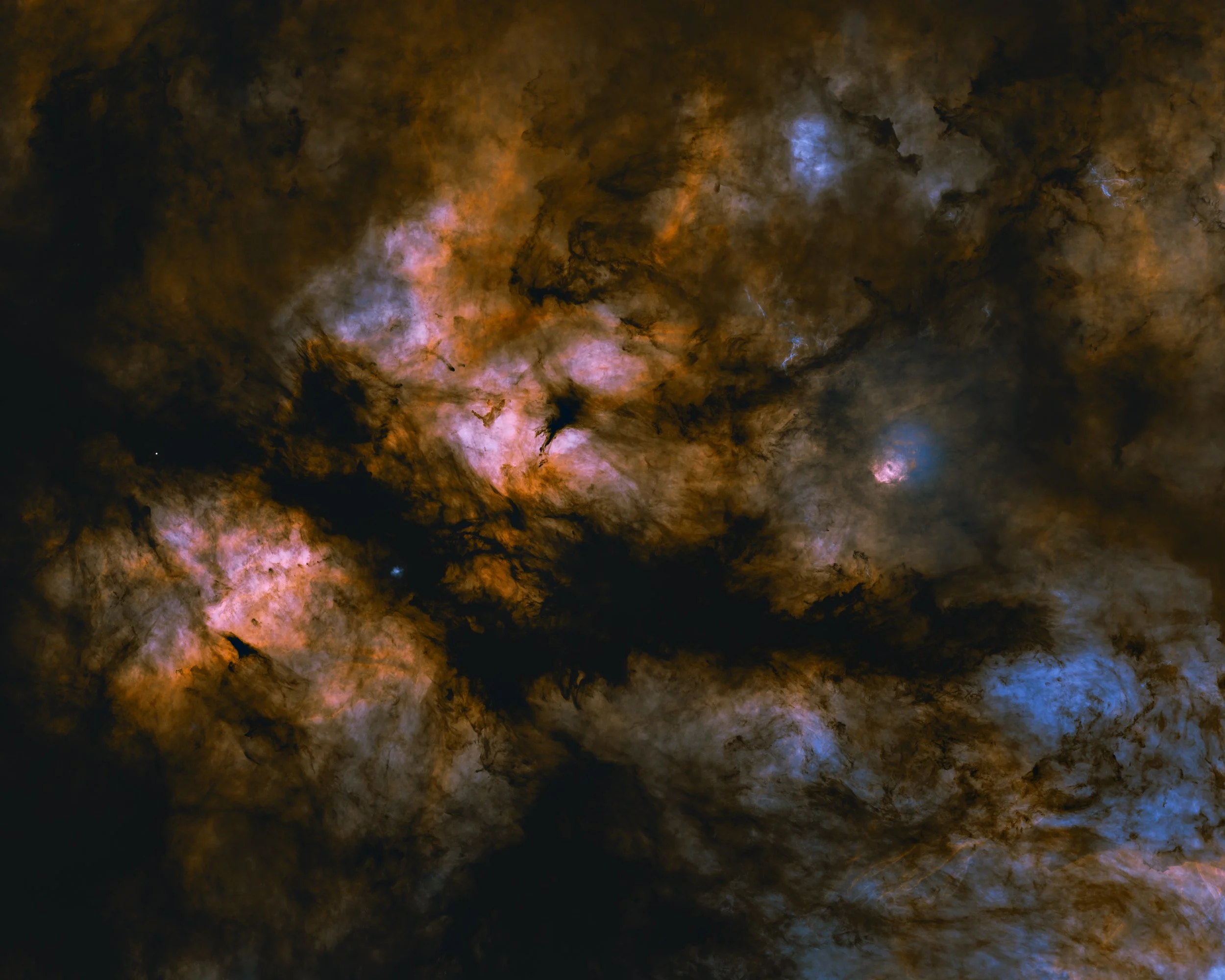
Starless Version
About the Subject
The Butterfly Nebula, also known as IC 1318, lies near the middle of the constellation Cygnus, high overhead in the summer months for northern hemisphere observers. It is a massive H II region filled with glowing gas, dark nebulae, and young open clusters. The bright star near the center right of the image is Sadr (Gamma Cygni). The two lobes of glowing gas on the left of the image give dissected by a dark dust lane give the Butterfly Nebula its name.
IC 1318 is part of the much larger Cygnus-X molecular cloud, perhaps the most massive molecular complex within the Milky Way with a total mass of three million Suns. It lies at a distance of roughly 4,000 light years. While the bright star Sadr lies in the same direction as the nebula, it is actually a foreground object.
About the Image
This is a two panel mosaic captured between July 12th and August 19th 2026. It is a narrowband image with RGB stars. The image is shown using a palette similar to Hubble’s sulfur, hydrogen, oxygen images, but using just hydrogen and oxygen data. The synthetic “sulfur” red channel was synthesized from the HOO data to roughly mimic the distribution of sulfur as seen in true SHO images.
Location and Equipment:
Rowe, NM, USA
Astro-Physics 305mm Riccardi-Honders Cassegrain @ f/3.8
Astro-Physics 1100GTO AE Mount with Absolute Encoders
QHY600PH Monochrome Camera at 0°C
Chroma 50mm x 50mm filters
3nm H-Alpha, 3nm OIII, Red, Blue, and Green
51h 20m H-alpha, 0h 40m luminance (mosaic total across six panels)
17h 5m total integration time across the various filters and panels
Software:
Astro-Physics APCC for mount control and advanced pointing model
NINA for autofocus, sequence of images, and camera control
PHD2 for guiding
PixInsight for calibration and all post processing