
Horsehead Nebula in H-Alpha
About the Object:
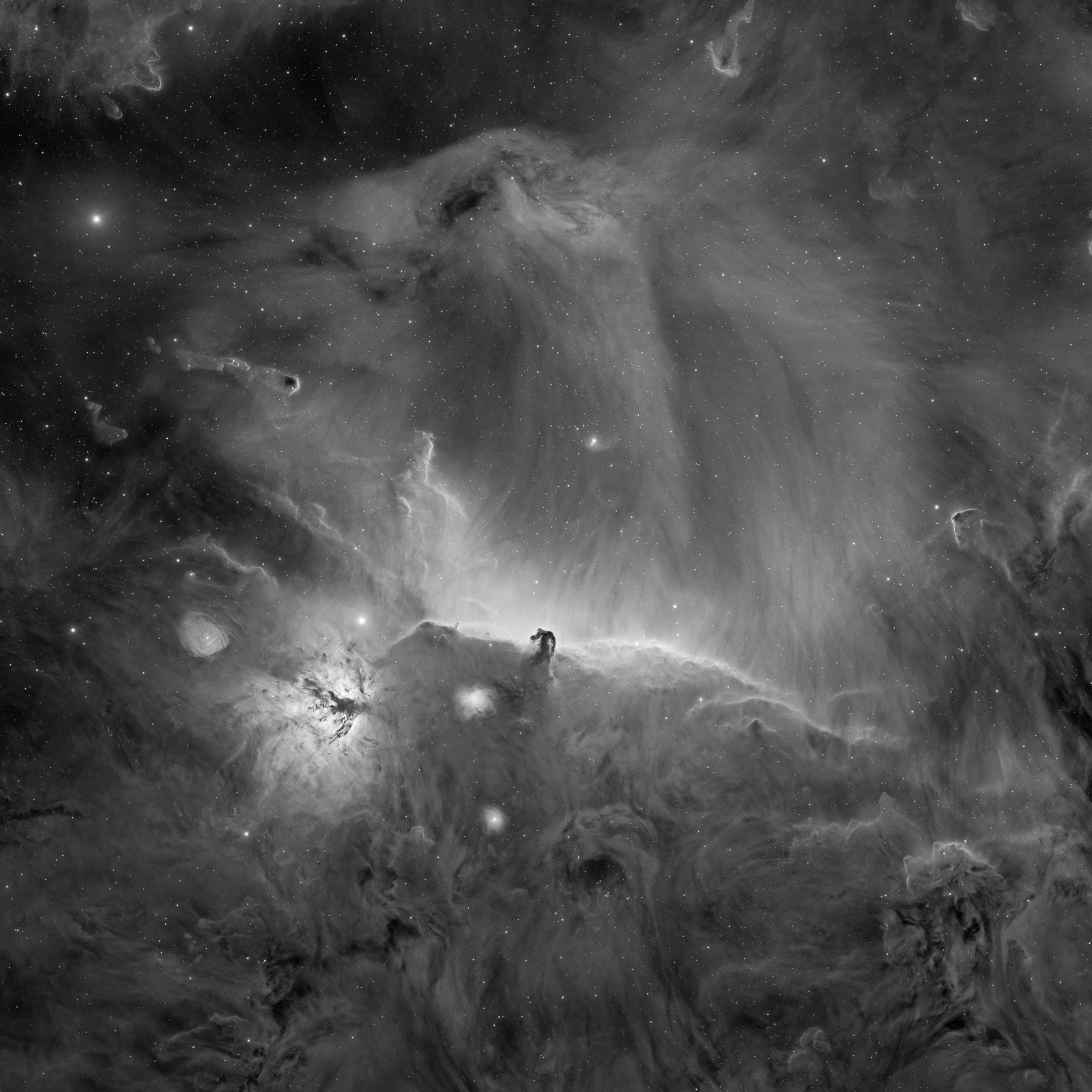
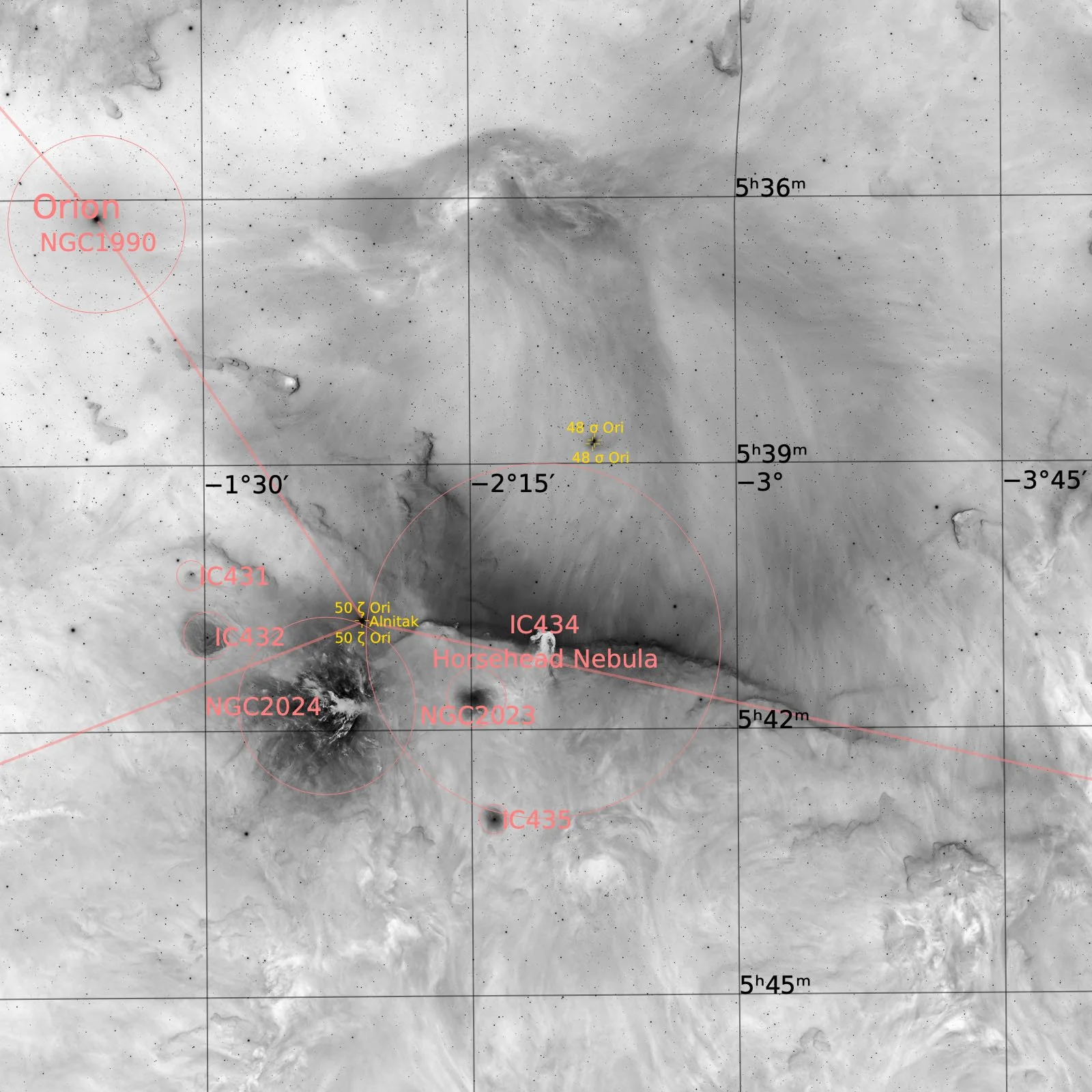
The Horsehead (just below the center of the frame) and the Flame Nebulae (left of center) are shown in this image. The Horsehead, also known as Barnard 33, is a dark silhouette in front of the bright emission nebula IC 434. It was first recorded on a photographic plate taken by Williamina Fleming in 1888 at Harvard College Observatory. Edward Pickering, the director of the observatory at the time, credited Williamina with the discovery, though John Louis Dreyer, who was updating the general catalog of nebulae and star clusters at the time, was not so "generous" and removed Fleming as the discoverer and replaced her name with Pickering's. The omission was eventually corrected, but not for twenty years.The Flame Nebula is a similar combination of bright emission nebula and obscuring foreground dust and gas creating a complex structure that appears to resemble a campfire in space. At the center of the Flame Nebula lies a cluster of newly formed stars many of which still show circumstellar disks, donut shaped accretions of material that may eventually become planetary systems. The cluster is only seen in infra-red images which can penetrate the obscuring dust.The Horsehead and Flame along with all of the surrounding hydrogen gas visible within this image are part of the much larger Orion Molecular Cloud complex. The gas in this image is glowing because it is fluorescing under powerful ultraviolet light from several stars within the image. The gas around the Horsehead is likely glowing because of Sigma Orionis (the bright multiple star above and a little to the right of the Horsehead), while the source of UV radiation for the Flame nebula is thought to be Alnitak, the bright star just above the Flame..
About the Image:
The image is a combination of red light taken through a three nanometer bandpass hydrogen-alpha filter mixed with a small amount of luminance data. Because the Horsehead and the surrounding grass clouds cover a large amount of sky, a six panel mosaic was used for this image. The vast majority of the signal, including virtually all of the Horsehead and the Flame nebulae, consist of just H-Alpha data. The luminance data were used to enhance the visibility of a few of the reflection nebulae in the image including NGC 2023 (below and left of the Horsehead), IC 435 (below NGC 2023), and IC 431 (to the left of the Flame Nebula). Aside from these three reflection nebula which shine brightest in blue light, the rest of the image is from glowing hydrogen gas.
Date, Location, and Equipment:
December 5 - 23, 2025, Rowe, NM, USA
Astro-Physics 305mm Riccardi-Honders Cassegrain @ f/3.8
Astro-Physics 1100GTO AE Mount with Absolute Encoders
QHY600PH Monochrome Camera at -20°C
Chroma 50mm x 50mm filters
3nm H-Alpha
Luminance
51h 20m H-alpha, 0h 40m luminance (mosaic total across six panels)
Software:
Astro-Physics APCC for mount control and advanced pointing model
NINA for autofocus, sequence of images, and camera control
PHD2 for guiding
PixInsight for calibration and all post processing
This is a monochrome image using a single narrowband filters capturing H-alpha along with a small amount of luminance data to enhance the reflection nbulae.