
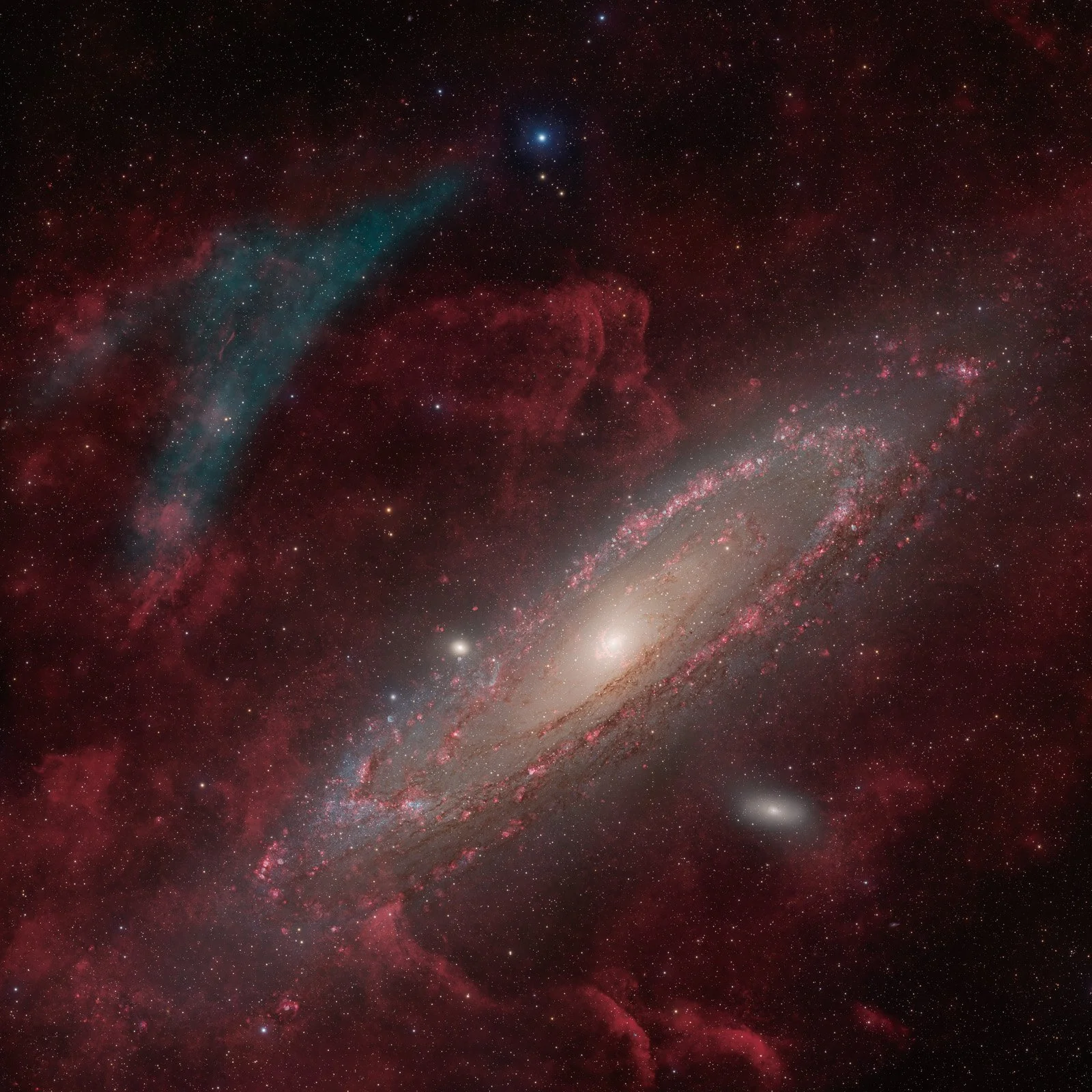
Andromeda and OIII Arc
About the Subject
After the Moon, the Andromeda Galaxy is perhaps the most photographed object in the night sky. Its distance of 2.5 million light years makes it the Milky Way’s closest spiral neighbor. It is a bit larger than the Milky Way, both in diameter and in mass. Based on the rotation rate, it is thought to have a mass of roughly one trillion suns. From a dark sky, it is faintly visible to the naked eye.
In addition to the galaxy itself, you will notice lots of little red patches scattered around the disk of Andromeda. Those are star forming regions—emission nebulae of ionized hydrogen gas. They were captured through a narrowband H-Alpha filter that lets in just that one color of light. This hydrogen light can then be boosted or stretched independent of the rest of the galaxy to highlight the nebulae.
It looks like the galaxy is swimming in a sea of red nebulosity, though. While it is true that the Andromeda Galaxy is surrounded by a halo of atomic hydrogen and a filament of neutral hydrogen gas that connects it to the Triangulum Galaxy, that isn’t what you see here. That hydrogen does not glow in the visible part of the spectrum—it can only be seen at radio frequencies. The “sea” of nebulosity you see surrounding Andromeda here is mostly foreground clouds of gas within our own Milky Way. The exposures intended to show the star forming regions within Andromeda picked up these clouds as well.
The most unusual part of the image, though, is the blue-green arc of ionized oxygen seen above and to the left of Andromeda. It was discovered in 2022/2023 by amateur astrophotographers Marcel Drechsler, Yann Sainty, and Xavier Strottner and is officially cataloged as Strottner-Drechsler-Sainty Object 1. Despite the fact that astronomers have been photographing Andromeda for 135 years, nobody had ever seen this object before. It’s not that the arc suddenly appeared, it was missed because it is just far enough away from Andromeda that many photographs of the galaxy didn’t cover that part of the sky, and because it is insanely faint. My photograph included roughly eighty hours of exposure for OIII across the six panels, yet the arc is barely resolved and appears quite blotchy due to the limited data (only about thirty hours of OIII in the two panels that cover the arc). In order to show more details in the arc additional OIII data are needed. Drechsler et al collected over 100 hours of data on the arc alone.
The exact nature of the arc is still under investigation, but the leading theory is that it is a shock front from a “Ghost Planetary Nebula” within our own Milky Way. This is based upon follow-up observations since 2022 including spectral analysis of the object.About the Image
Six panel mosaic captured between August 27th and November 26th from Rowe, NM using a 305mm aperture Riccardi-Honders telescope mounted on an AP1100GTO AE german equatorial. The camera used was a QHY600PH monochrome cooled to -10°C. Three nanometer bandpass 50mm x 50mm Chroma filters were used to capture hydrogen alpha emissions (red) and doubly ionized oxygen (teal). Star colors are from separate RGB exposures. Total integration time was 182 hours.