
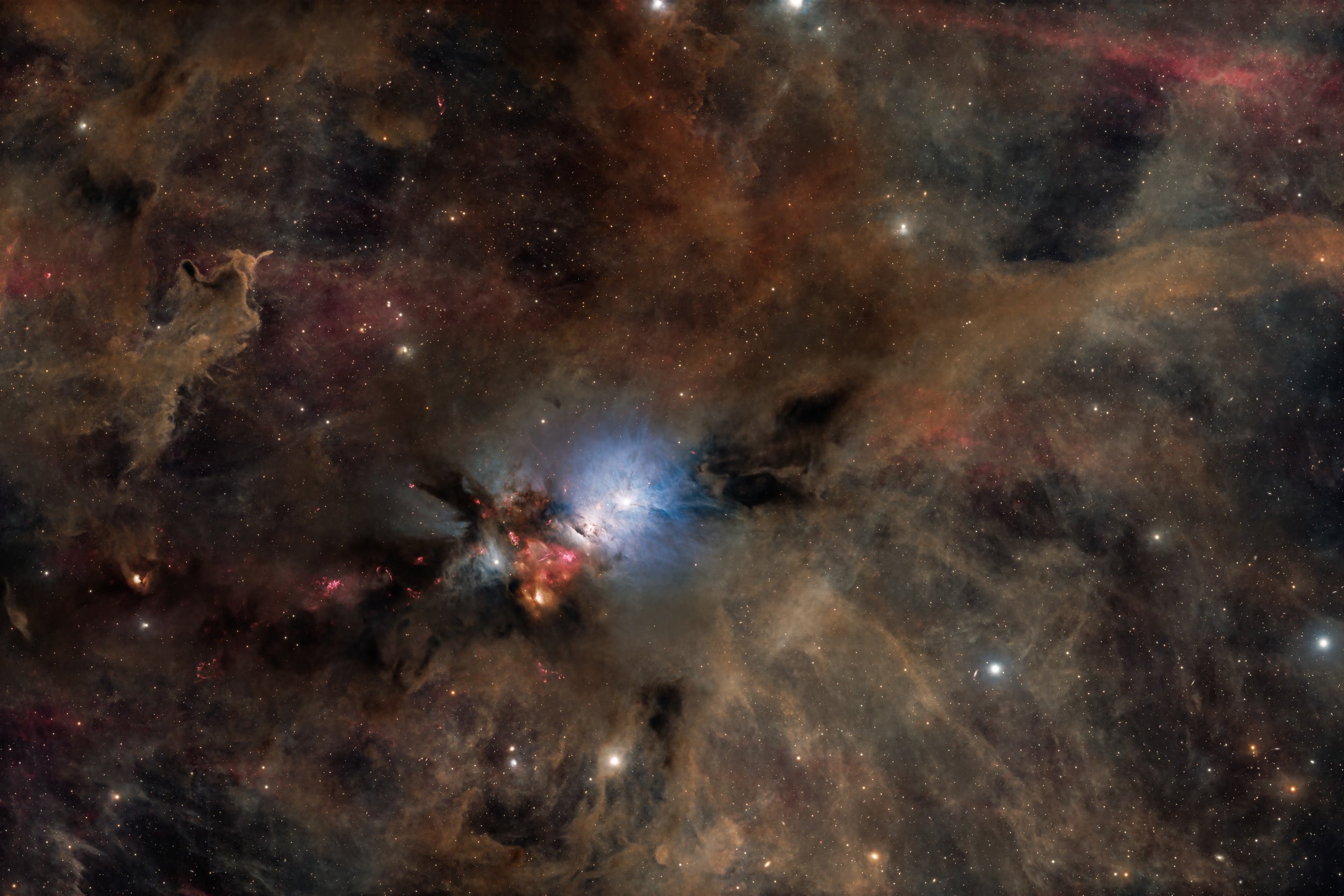
Crop of NGC 1333 Core
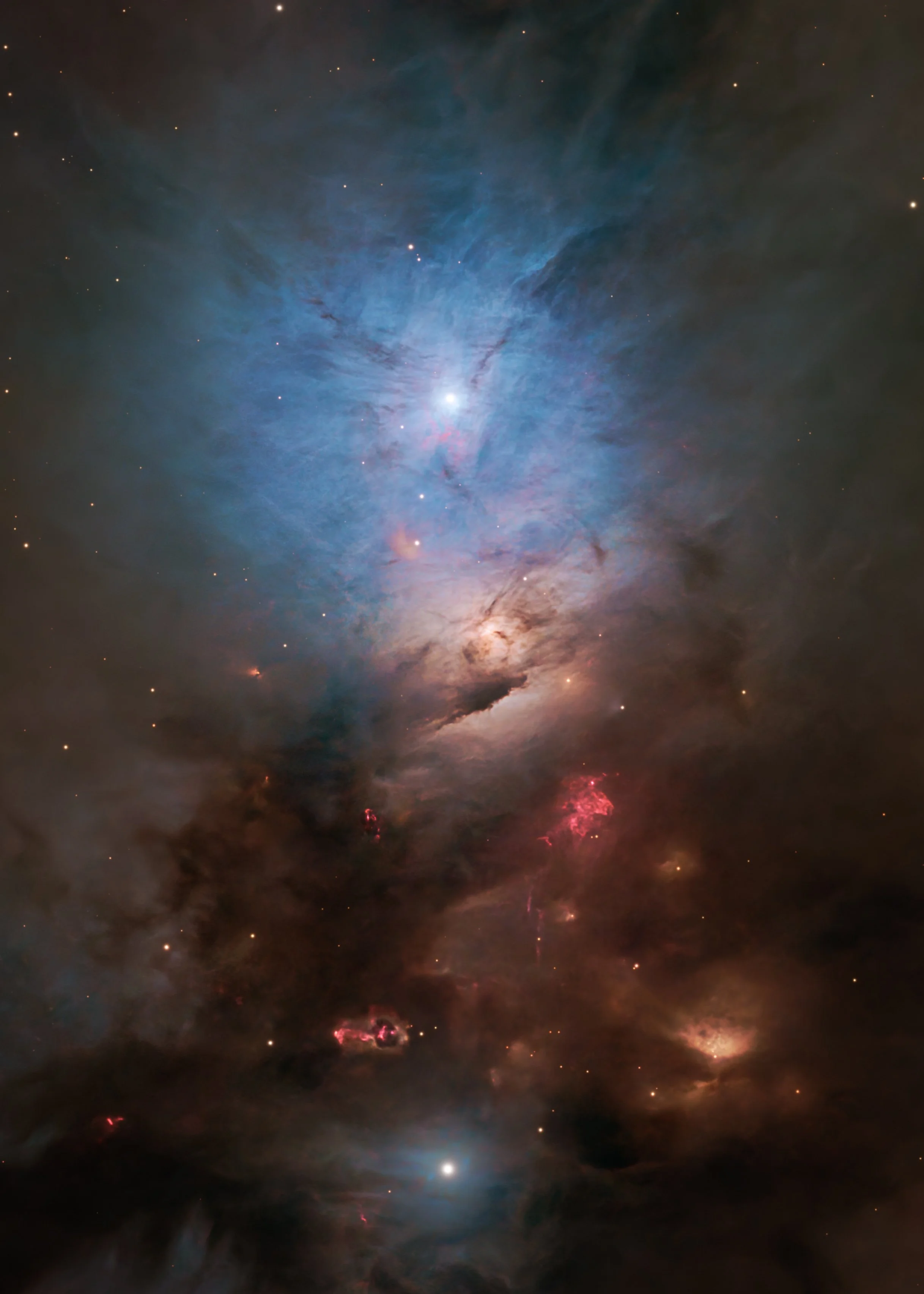
Annotated Herbig-Haro (HH) Objects
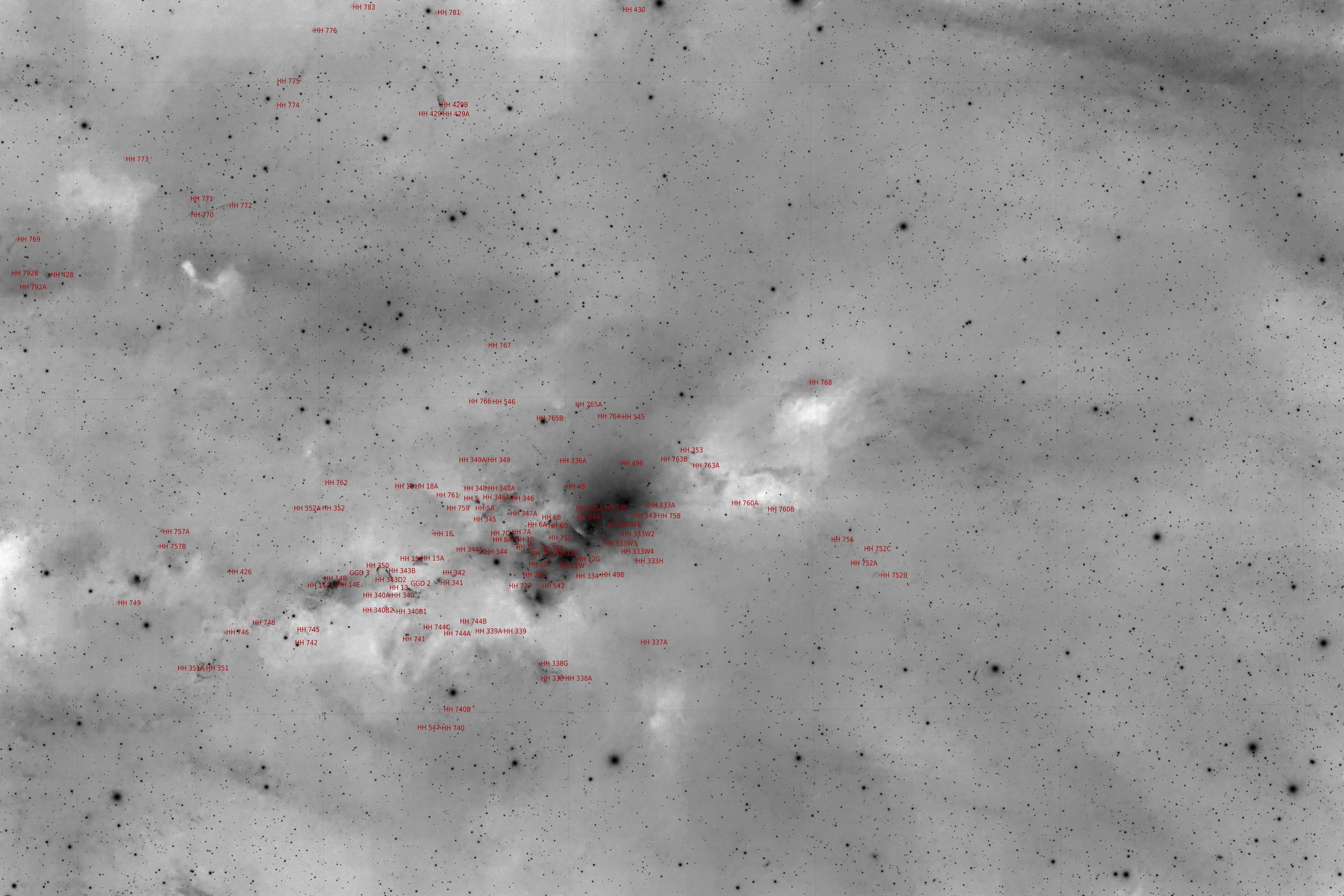
NGC 1333, The Embryo Nebula
About the Subject
NGC 1333 is a reflection nebula and an active star-forming region located in the constellation Perseus, approximately 960–1,000 light-years from Earth, within the Perseus molecular cloud complex. It lies along the edge of a vast cloud of cold molecular gas and interstellar dust, where gravity is triggering the formation of new stars. The nebula’s characteristic blue glow is produced by starlight scattered and reflected by surrounding dust, while dark lanes of obscuring material conceal much of the activity taking place within. NGC 1333 is one of the nearest laboratories for studying early stellar evolution, containing hundreds of very young stars, many less than one million years old.
NGC 1333 has been catalogued and studied since the nineteenth century, appearing in the New General Catalogue compiled by John Louis Emil Dreyer and published in 1888. Although initially recognized primarily for its nebulosity, subsequent observations across optical, infrared, radio, and X-ray wavelengths have revealed a complex stellar nursery rich in protostars, circumstellar disks, and energetic outflows. Optical observations reveal the interplay between luminous reflection nebulae, dense dust clouds, and glowing emission features.
One of NGC 1333’s most remarkable features is its abundance of Herbig–Haro (HH) objects: small, luminous patches of gas created when high-speed jets from newly forming stars collide with surrounding material, heating and exciting the gas until it emits light. Numerous examples, including members of the HH 7–11 group, are found throughout the region, marking the locations where powerful protostellar outflows interact with the interstellar environment. These objects often appear as compact red knots or elongated, bow-shaped structures, particularly prominent in hydrogen-alpha and other emission-line images.
About the Image
The data for this image were captured between September 28th and October 21, 2026 from Deep Sky West observatory in Rowe, NM. NINA was used for image capture, APCC was used to control the mount, and PixInsight was used for image pre-processing and post.
Location, and Equipment:
Rowe, NM, USA
Astro-Physics 305mm Riccardi-Honders Cassegrain @ f/3.8
Astro-Physics 1100GTO AE Mount with Absolute Encoders
QHY600PH Monochrome Camera at -10°C
Chroma 50mm x 50mm filters
3nm H-Alpha
RGB
Total integration time of 50h 24m (11h 58m red, 11h 32m green, 11h 24m blue, 15h 20m Ha)
Software:
Astro-Physics APCC for mount control and advanced pointing model
NINA for autofocus, sequence of images, and camera control
PHD2 for guiding
PixInsight for calibration and all post processing