
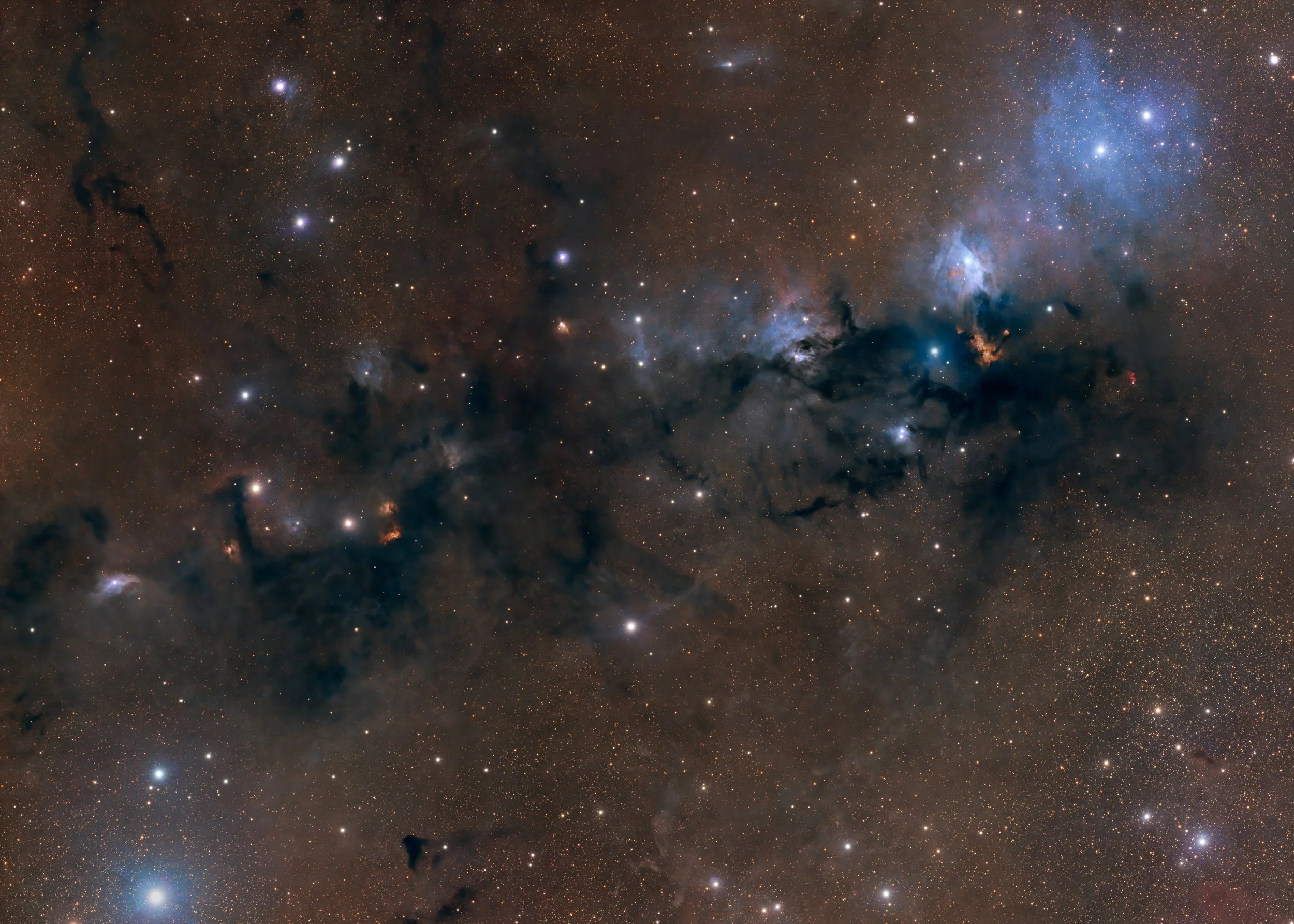
VdB 123 and the Serpens Nebula
About the Subject
The northern constellation Serpens is split into two parts, the head of the serpent and the tail. Serpens Cauda, the tail of the serpent, is an area rich in deep sky objects. The It contains large scale dust lanes forming dark nebulae (where the dust literally hides the background stars), star forming regions where protostars can be observed in near infrared light, reflection nebulae where new stars have formed and their light is being scattered by the surrounding dust and gas. The brightest blue area near the top right of this image is Van den Bergh 123, a reflection nebula being illuminated by the star HD 170634. The hot, blue star’s light is scattered off the dust in the Serpens Molecular Cloud, causing the bright blue nebulosity seen towards the top right of the image.
Just below VdB 123 lies the Serpens Reflection Nebula (SRN), the large-ish orange area above and right of the center of the frame. At a distance of 1,300 light years, this reflection nebula is one of the closest stellar nurseries to Earth and so is intensely studied by professional astronomers to improve our understanding of how stars form.
Most of the background stars in this image appear red or orange because their light has been filtered through large quantities of dust, scattering and absorbing much of the blue light produced. The dark, almost black areas of the image do not indicate an absence of stars. Instead, these are places where dust is so dense that little if any starlight can get through to be seen from Earth.
About the Image
The image was captured between June 10 and June 23, 2026. Because of the relatively short summer nights, only 28 hours of total data were available. Data were acquired from Rowe, NM using a 305mm aperture Riccardi-Honders telescope mounted on an AP110TO AE german equatorial. The camera used was a QHY600PH monochrome cooled to -10°C. 50mm x 50mm red, green, and blue Chroma filters were used to capture the image.