
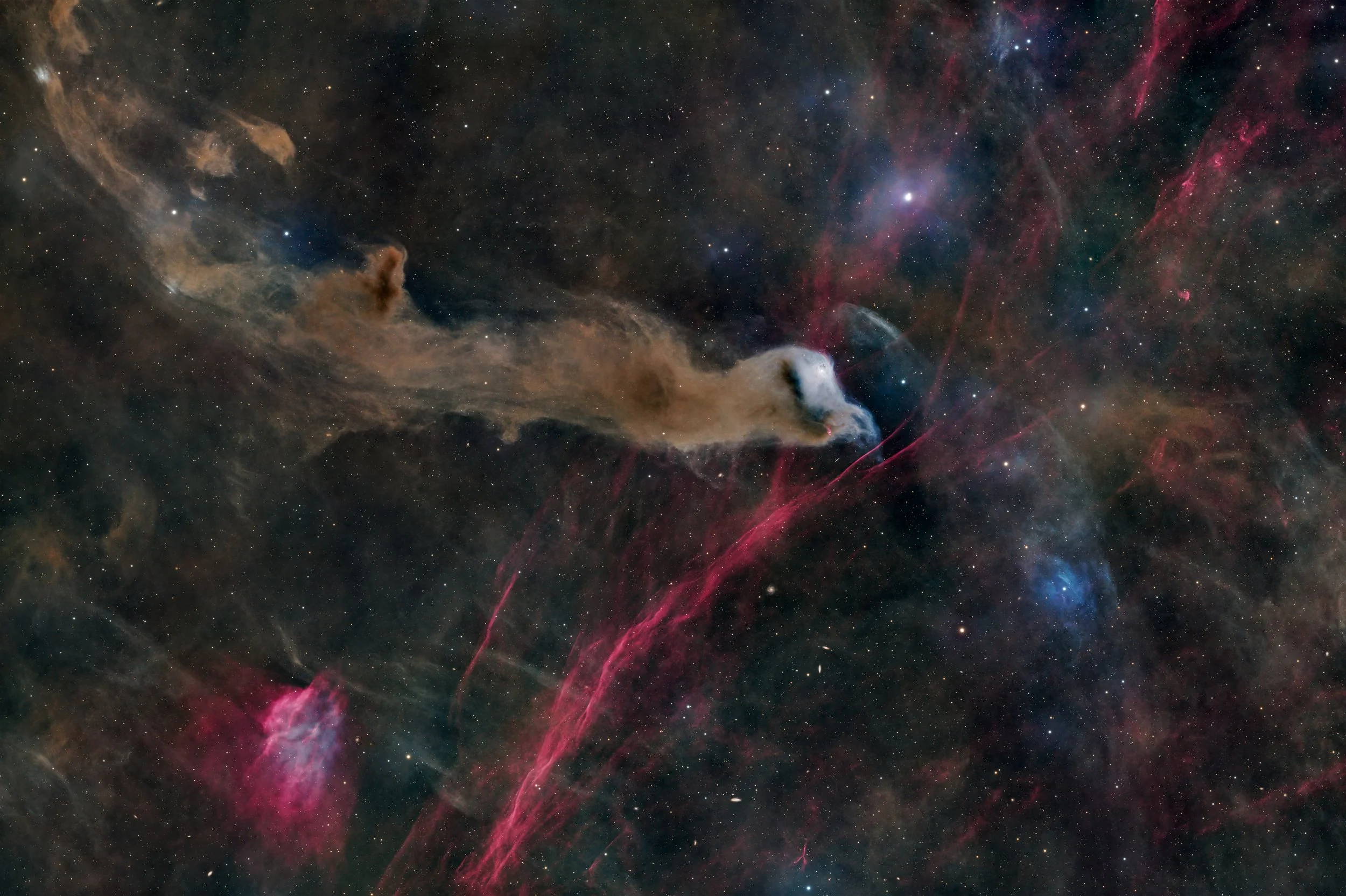
Wolf’s Cave Nebula
About the Subject
There’s a lot going on in this one. vdB 152, the Wolf’s Cave Nebula, is the bright blue reflection nebula at the tip of the dust cloud that dominates the image. A reflection nebula is a cloud of dust and gas in space surrounding a bright star or cluster os stars that shines by scattering the starlight, preferentially blue. The shorter the wavelength of light, the more easily it is scattered by dust and gas, so the blue starlight is what makes it to our eyes while many of the longer wavelengths of light simply pass through the dust and gas and continue into space. Vdd 152 is illuminated by the start BD+69 1231, the bright star embedded near the center of the brightest area of the reflection nebula.
vdB 152, however, is just at the tip of a larger gas and dust cloud called Barnard 175. B175 is a Bok Globule, a dark nebula containing dense cosmic dust and gas in which new star formation is thought to be taking place. B175 is the dark, crescent shaped shadow that almost seems to surround vdB 152. Bok Globules are generally about a light year across and can contain between two and fifty solar masses worth of molecular hydrogen, carbon oxides, helium, and silicate dust. They appear dark primarily because of the light absorption from the silicate dust.
The larger structure of dust and gas that contains vdB 152 as well as B175 is generally cataloged as LDN 1217. It’s the brown finger of gas and dust running across the image from the top left of the frame to just past the middle of the frame.
Just below vdb 152 you can see a tiny, red emission region. This is the Herbig-Haro object HH 450. Herbig-Haro objects form when high speed jets of material streaming out of a protostar collide with surrounding interstellar material. The partially ionized jets glow in much the same way a neon light glows. HH objects are relatively transient, typically lasting just a few tens of thousands of years.
Weaving throughout the image are ribbons of red, glowing gas. These are part of super nova remnant, SNR 110.3+11.3, located at about the same distance as vdB 152 and B175. It is not yet known whether the expanding material from the supernova remnant will collide with the dust and gas of the molecular cloud.
At the lower left of the image is the glowing blue and red region cataloged as planetary nebula DeHt5 (LBN 538). Dengel-Hartl 5 is an HII and OIII region, likely ionized by the white dwarf WD 2218+706 (the faint, blue star just to the right of center of the nebula). Beverly Lynds catalogued the brighter part of this nebula as LBN 538.
The Wolf’s Cave Nebula lies at a distance of roughly 1,400 light years and is part of the much larger Cepheus Flare, a complex of molecular clouds in the constellation Cepheus.
About the Image
This image was captured between September 9th and September 21, 2026. It is an RGB image that has been blended with narrowband H-alpha data to draw out the supernova remnant.
Location and Equipment:
Rowe, NM, USA
Astro-Physics 305mm Riccardi-Honders Cassegrain @ f/3.8
Astro-Physics 1100GTO AE Mount with Absolute Encoders
QHY600PH Monochrome Camera at -10°C
Chroma 50mm x 50mm filters
3nm H-Alpha, Red, Blue, and Green
23h 48m total integration time
Software:
Astro-Physics APCC for mount control and advanced pointing model
NINA for autofocus, sequence of images, and camera control
PHD2 for guiding
PixInsight for calibration and all post processing